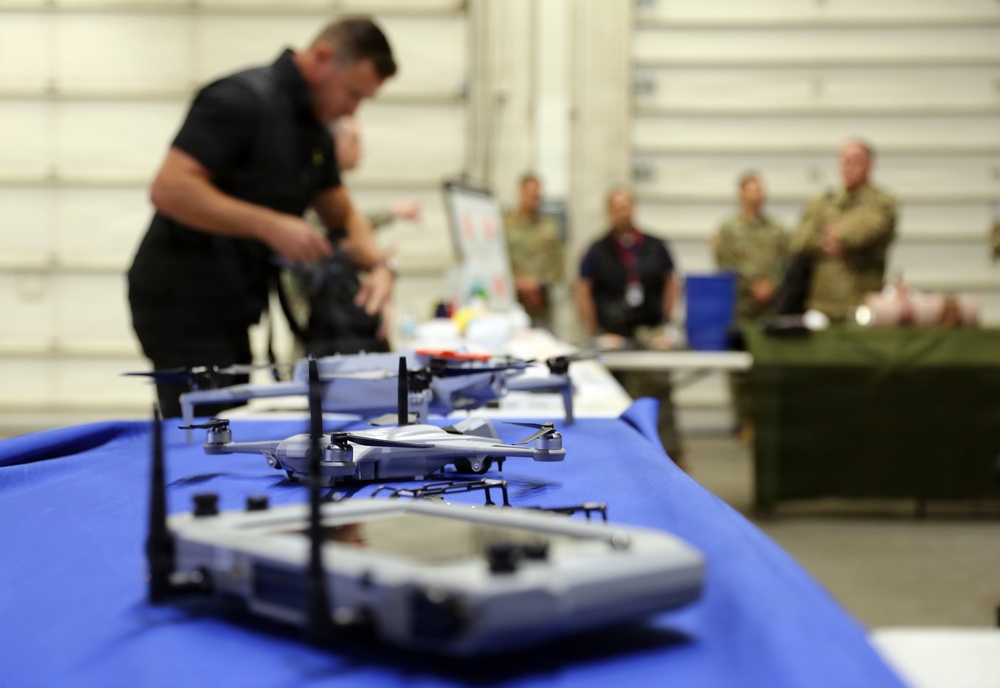
A drone comes over the wire at a county jail. The shift supervisor knows what it is, knows roughly where it came from, and knows the contraband will be on the yard in ninety seconds.
Since July 1, 2026, there is a federal framework that says what he may lawfully do about it. Whether his agency may do any of it depends on two things that most coverage of this rule has collapsed into one.
The rule made authority real, then put one door in front of it
The SAFER SKIES Act was enacted as part of the FY2026 National Defense Authorization Act — Public Law 119-60, division H, title LXXXVI, sections 8601–8607, codified in large part at 6 U.S.C. 124n [VERIFIED against the IFR's authority note; a citation, not a quotation]. The implementing Interim Final Rule was issued jointly by the Department of Justice and the Department of Homeland Security at 91 FR 41466, effective July 1, 2026, with the comment period closing September 4, 2026 [REG-VERBATIM]. It is an interim final rule, which means it is in force and open for comment at the same time.
The rule designates the FBI's National Counter-UAS Training Center as "the national training center for purposes of 6 U.S.C. 124n and as the sole certifying authority for SLTT C-UAS mitigation operators under 6 U.S.C. 124n(d)(2)(A)(i)" [REG-VERBATIM]. One schoolhouse. Not a list of approved providers, not a reciprocity scheme — one.
The two keys
Authority is not held by a trained officer. It is held by an accredited agency deploying an individually certified operator, using a listed technology, under an approved operations plan. The rule is explicit that certification is personal: "Only those personnel who have completed the curriculum and passed the post-course assessment may exercise the authorities" [REG-VERBATIM].
Both keys must turn. An agency can send an officer to the schoolhouse and still lack authority, because the agency has not been accredited and has not adopted a counsel-reviewed implementation policy. An accredited agency with no certified operator is in the same position from the other direction. CONFIDENCE: HIGH — this is the plain structure of the rule, stated in the regulatory text rather than inferred from it.
The number the rule puts on its own capacity
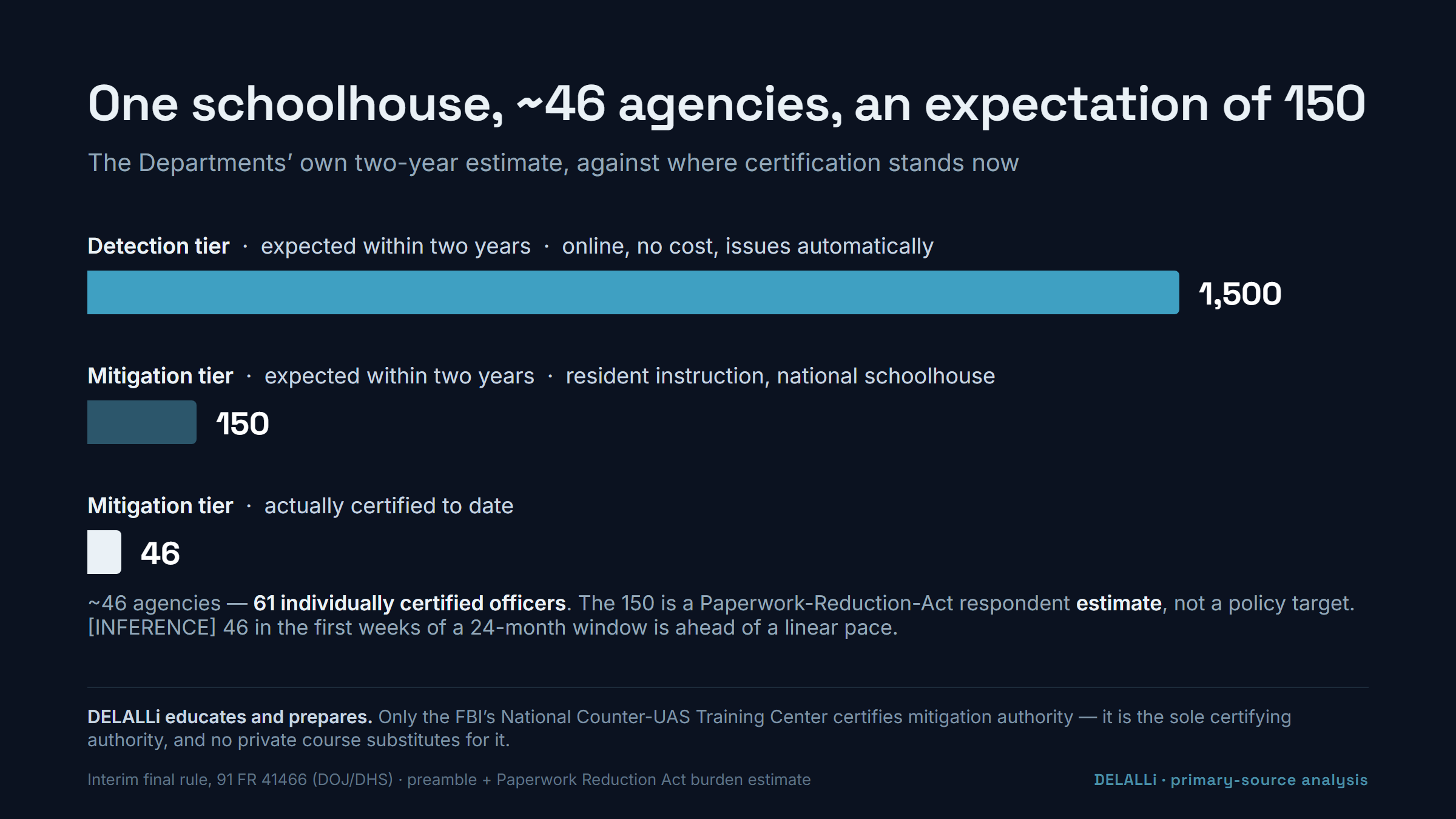 DELALLi graphic. Figures are the rule's own — see the citations below.
Here is what has not been widely reported, and it comes from the rule's own preamble and its paperwork-burden analysis rather than from anyone's commentary.
Certified to date at the mitigation tier:
"approximately 46 SLTT agencies have already completed training and certification through the NCUTC and stand ready to operate, reflecting 61 individually certified officers per NCUTC certification records" [REG-VERBATIM, 91 FR 41466]
What the Departments expect within two years:
"an expectation of approximately 1,500 detection-tier and 150 mitigation-tier participating agencies within the first two years" [REG-VERBATIM, 91 FR 41466]
Put those beside each other. The Departments' own two-year expectation for the mitigation tier is roughly 150 agencies. The schoolhouse is at approximately 46.
Three honest caveats before anyone reads that as a scandal, because it is not one:
- The 150 is a planning assumption, not a target. It appears exactly once in the rule, inside the Paperwork Reduction Act burden estimate — a respondent count used to compute paperwork hours. The 1,500 detection-tier figure has independent support in the substantive preamble; the 150 does not. Treating an administrative estimate as a policy goal would be reading it harder than it deserves.
- 46 of ~150 in the first weeks of a 24-month window is ahead of a linear pace, not behind it. [INFERENCE - arithmetic against the rule's own two-year framing; the rule states no schedule.] The window opened July 1, 2026.
- The Bureau says capacity is being added. The rule states the NCUTC "is conducting additional classes on a continuing schedule, and is expanding the instructor cadre and course frequency to support broader SLTT agency enrollment beginning later in 2026" [REG-VERBATIM].
What the numbers do support is narrower and still useful: mitigation certification is the scarce thing in this framework, and it is scarce by design — one schoolhouse, resident instruction, a national queue. CONFIDENCE: HIGH on the figures as quoted; MODERATE on any characterisation of whether the pace is adequate, which depends on demand nobody has measured.
The trajectory is independently visible. In Senate Appropriations testimony, FBI Special Agent in Charge Douglas Olson reported that "as of April 2026, the NCUTC has certified 45 SLTT law enforcement officers … with an additional class in progress and projected to bring the total to 61 prior to the start of" the World Cup [VERIFIED, pinned testimony]. The projection was met. It is also, as of the rule's publication, still the number.
The part almost everyone misses
The Departments' own estimate anticipates roughly ten times as many agencies at the detection tier as at the mitigation tier — 1,500 against 150. Both numbers come from the same burden analysis, so the ratio is as soft as its inputs; what it is evidence of is that the government drafting the rule expected most agencies to enter at the detection tier. [INFERENCE from the burden estimate, not a stated policy objective.] That is the on-ramp worth looking at.
Detection and warning certification does not run through the residential course:
"the detection and warning curriculum is delivered online at no cost through the NCUTC training portal, and certification issues automatically upon completion" [REG-VERBATIM]
And a category of activity sits outside the certification requirement altogether. Systems that intercept no communications — cameras, acoustic sensors, radar operated under FCC authorization — do not require the Act's authority, and so "detection and warning activity conducted using systems that do not require the authority of 6 U.S.C. 124n is not subject to this requirement" [REG-VERBATIM].
The practical read: an agency nowhere near the residential course can still build passive detection and situational awareness now, and can put its people through a free online certification now, while it works the accreditation problem in parallel. CONFIDENCE: HIGH on the mechanics as quoted; MODERATE that this is the right sequencing for any particular agency — that depends on its mission, its counsel, and its spectrum posture.
What the rule demands once you operate
Two obligations worth knowing before anyone signs an operations plan. Activate a mitigation system and the agency must notify the FAA's designated point "within five minutes of activation or as soon as operationally practicable" (section 124.11) [REG-VERBATIM]. Mitigation actions carry a report "within 48 hours" (section 124.13) [REG-VERBATIM], plus a semiannual operational summary.
The Act also did not waive the Communications Act. Radio-frequency-emitting systems still need FCC authorization on their own track.
Who cannot help you with the certification
Plainly, because the rule says it plainly: "Detection and Warning Certification is issued only by the NCUTC, and detection and warning training or certification obtained from another agency or a private entity does not satisfy this requirement" [REG-VERBATIM].
That includes us. DELALLi teaches this framework and prepares agencies and officers to work inside it. It does not certify anyone, and no private course shortens the queue at the national schoolhouse. Anyone telling you otherwise is describing something the rule forecloses in a single sentence.
What to do with the days that are left
The comment period on this rule closes September 4, 2026, at 11:59 p.m. ET — the electronic docket accepts comments "until 11:59 p.m. Eastern Time on that date" [REG-VERBATIM, 91 FR 41466]. The rule sets no grace period and promises nothing about anything filed later. [INFERENCE — the IFR states the cutoff, not a consequence.] The Departments specifically invited comment on whether certifications should expire — 36 or 48 months were floated — which is a question every agency planning a multi-year program has a stake in answering.
If the queue is the binding constraint on your agency's ability to use authority Congress granted it, the rulemaking record is the place to say so. It is open now, and it will not reopen.
Brian Rutherford is a Marine Corps Reconnaissance veteran and a certified combat marksmanship and foreign weapons instructor, an FAA Part 107 certificated pilot, and a former federal government contracting CEO (2009-2013). He founded DELALLi, which builds readiness training for state, local, tribal, and territorial agencies. Every regulatory figure in this piece is quoted from the Interim Final Rule at 91 FR 41466 or from a pinned primary source; none is drawn from secondary reporting. Bold emphasis inside quoted regulatory text is added for readability unless the source itself emphasises it; the words are unaltered.
Stay Informed on Drone Threats
Weekly intelligence on C-UAS developments, regulatory changes, and security insights from a Part 107 pilot and defense veteran.
Unsubscribe anytime. We never share your address — privacy policy.