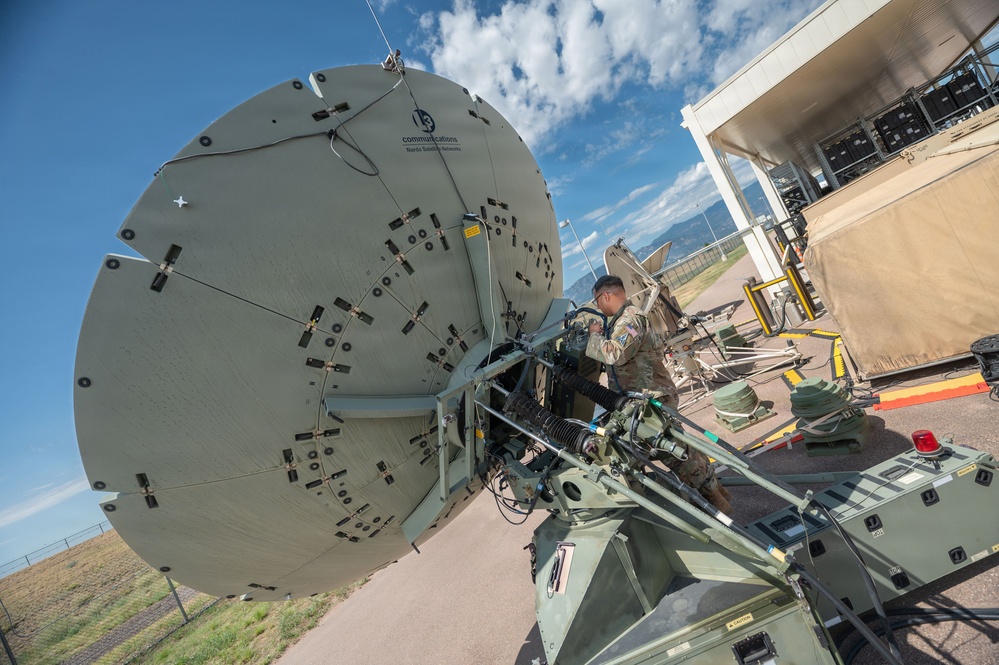
There are two different permissions involved in operating a counter-drone system, they come from two different agencies under two different statutes, and only one of them is durable.
Most coverage of the new authority has been about the first. This is about the second.
The Act did not touch the Communications Act
The interim final rule is unusually direct about this:
"…the SAFER SKIES Act did not amend or waive the applicability of other Federal statutory provisions that may govern or proscribe SLTT agencies' otherwise authorized activity, including those in the Communications Act or other regulations governing access to spectrum. See, e.g., 47 U.S.C. 301 (licensing and authorization), 47 U.S.C. 302 (interfering devices), 47 U.S.C. 333 (jamming), 47 U.S.C. 605 (unauthorized transmissions)." [REG-VERBATIM, 91 FR 41466]
And the operative requirement, at section 124.9(f):
"Before deploying any C-UAS system (whether detection and warning only or mitigation) that involves the emission of radio waves, an SLTT law enforcement or correctional agency must obtain authorization to use that system consistent with Title III of the Communications Act of 1934, as amended." [REG-VERBATIM]
Read the parenthetical twice. Detection-only is included. An agency that concluded it could skip the federal certification queue by staying at the detection tier — which is a sound reading of the training rule — has not thereby skipped the spectrum requirement. If the box emits, it needs FCC authorization.
And here is the trap, because two different exemptions are in play and they do not cover the same equipment.
For the training requirement, the rule's test is whether a system intercepts communications. Cameras, acoustic sensors, and radar under FCC authorization intercept none, so no NCUTC certification attaches to them.
For the spectrum requirement, the test is whether the box transmits. Radar does, and the rule says so by name:
"RF-emitting C-UAS system means any C-UAS system that, when employed for detection or mitigation purposes, actively transmits radio frequency energy to detect, disrupt, disable, or seize control of a UAS or unmanned aircraft. This includes systems employing technologies for detection-only purposes, such as radars that transmit radio frequency signals, that may require a radiolocation service license to be issued from the Federal Communications Commission…" [REG-VERBATIM, 91 FR 41466, section 124.2; emphasis added]
So a radar unit can be simultaneously outside the certification requirement and squarely inside the FCC one. The only gear fully outside both is what transmits nothing at all: electro-optical and infrared cameras, and acoustic sensors.
Get this backwards and you buy a "detection-only, no certification needed" system that still needs a radiolocation licence nobody applied for.
What the FCC did about it
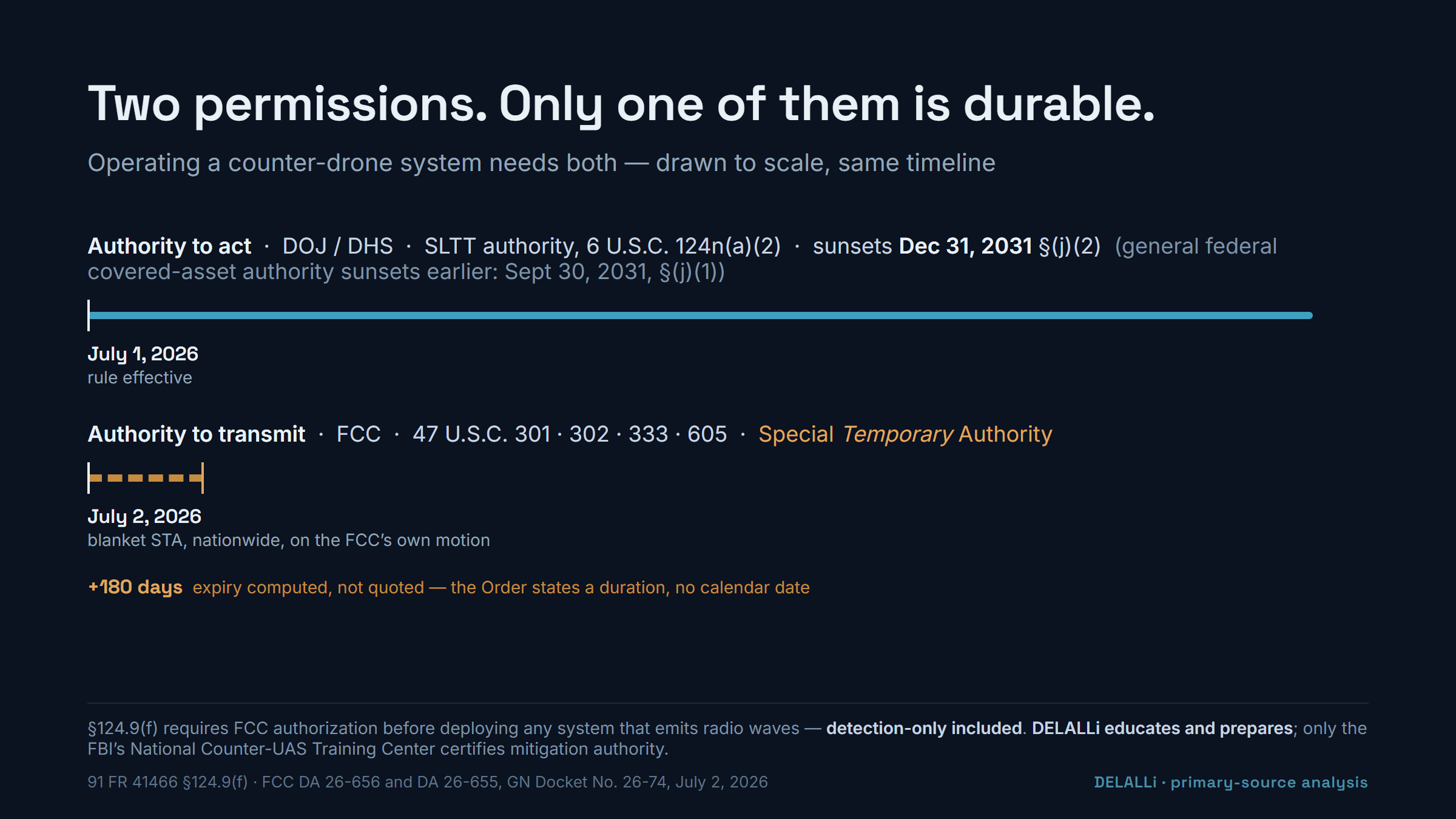 DELALLi graphic. The underlying FCC actions are cited in the sections above and below.
On July 2, 2026 — the day after the rule took effect — five FCC bureaus acted together (Wireless Telecommunications; Engineering and Technology; Public Safety and Homeland Security; Space; Media) [VERIFIED, FCC DA 26-656 signature block]. The Order:
"…conditionally grant Special Temporary Authority (STA) on our own motion for 180 days to State, local, Tribal, and territorial (SLTT) law enforcement and correctional agencies to conduct C-UAS operations that comply with the SAFER SKIES Act. … the Bureaus also waive Commission rules to the extent necessary to permit these C-UAS activities." [REG-VERBATIM, FCC DA 26-656]
And the scope. The Order's own grant sentence, from its operative clause onward:
"…we grant on our own motion an STA for 180 days for SLTT law enforcement and correctional agencies[18] to conduct C-UAS activities nationwide using any system on the Authorized Systems List jointly maintained by DOJ, DHS, Department of Defense, Department of Transportation, National Telecommunications and Information Administration, and the FCC.[19]" [REG-VERBATIM, FCC DA 26-656 ¶7; emphasis added]
(Two mechanical notes. [18] and [19] are inline footnote markers in the original, shown here because they fall inside the sentence; markers that sit at the very end of a quoted passage are dropped without comment elsewhere in this piece. And in the retrieved copy a printed footnote block plus a page header sit between "and the" and "FCC." — the sentence is continuous in the Order and is reproduced continuously here; the interruption is page furniture, not missing text. Two earlier drafts of this article got this sentence wrong: the first completed the list from a different paragraph and presented the splice as one quotation, the second stopped six words early and claimed the tail was unreadable. It is readable. It is one word.)
The same six agencies appear again at ¶4, in the Order's background section:
"…SLTT law enforcement and correctional agencies must use authorized 'systems or technologies' that are included on one of two lists maintained jointly by the Department of Justice (DOJ), Department of Homeland Security (DHS), Department of Defense, Department of Transportation, National Telecommunications and Information Administration, and the Federal Communications Commission (FCC or Commission)." [REG-VERBATIM, FCC DA 26-656 ¶4; emphasis added]
Six agencies in the Order — and the FCC is one of them. So the tidy "two agencies, two permissions" framing this article opened with is a simplification, and this is where it frays: the Commission granting the spectrum authority is also a co-maintainer of the equipment list that authority is scoped to. The statute says the same, at 6 U.S.C. 124n(d)(2)(A)(iii).
The codified rule says something slightly different, and the difference is worth a sentence because it is the kind of thing that decides an eligibility argument later. 6 CFR § 124.7(a) enumerates the maintainers as:
"Both lists are maintained jointly by the Department of Justice, the Department of Homeland Security, the Department of Defense, the Department of Transportation and Federal Aviation Administration, the Federal Communications Commission, and the National Telecommunications and Information Administration…" [REG-VERBATIM, 6 CFR § 124.7(a); emphasis added]
The FAA is named there and is not named in the Order's list or the statute's. Whether that is a substantive addition or a drafting expansion of "Department of Transportation," I do not know — CONFIDENCE: INSUFFICIENT, and I am not going to guess about which federal bodies hold a vote on an equipment list. What matters practically is that the list is interagency and the FCC sits on it.
(An earlier draft of this paragraph cited § 124.7(f) for the enumeration. That paragraph is titled "Maintenance of the lists," names no agencies at all, and cross-references the interagency process — the enumeration is at § 124.7(a). The Order's own footnote pointed at the process, and this article followed the footnote instead of reading the paragraph. Corrected before publication.)
None of this changes what an agency has to do. It does mean the two tracks are more entangled at the federal level than a two-lane picture suggests — and it is a reason to expect the spectrum question to be resolved alongside the training framework rather than separately from it.
A companion declaratory ruling the same day addressed the section 333 prohibition on willful or malicious interference. Quoted through its qualifier, because the qualifier is the point:
"…does not apply to the testing and use of Counter-Unmanned Aircraft System (C-UAS) technologies by the federal government, including C-UAS mitigation technologies that cause intentional interference such as signal jammers." [REG-VERBATIM, FCC DA 26-655; emphasis added]
Read the last three words. That ruling is about federal operations. The Commission goes on to address non-federal entities the government relies on, so state and local agencies are not left out — but their coverage is derivative, and the headline sentence is not about them. Do not let a vendor quote you the first half.
This was good, fast regulating. Nobody had to file. The FCC moved on its own motion and covered the country.
The part with a clock on it
BOTTOM LINE: the blanket spectrum permission is temporary by construction. "Special Temporary Authority" is what it says it is, and the Order grants 180 days from July 2, 2026.
The Order fixes the start and the length, and nothing else:
"The STA will commence on July 2, 2026, and continue for 180 days." [REG-VERBATIM, FCC DA 26-656]
One hundred eighty days from July 2, 2026 lands on December 29, 2026 — or December 28 if the first day counts, which the Order does not say. That date is arithmetic, not a quotation; the Order states a duration and prints no calendar expiry, and this piece is not going to dress a computed figure as a sourced one. CONFIDENCE: HIGH on the grant, the start date and the 180-day length, all quoted above; the expiry follows from them, to within a day.
What happens at the end of that window is not addressed in the Order text quoted here. The Commission may extend it, replace it with a permanent authorization framework, or require agencies to seek individual authority. CONFIDENCE: INSUFFICIENT on which — I do not know, and neither does anyone quoting this Order. Anybody who tells you they know what the FCC will do in GN Docket No. 26-74 is guessing.
Why this belongs in a budget conversation
FY2026 grant money is being spent now on equipment that operates under a temporary authorization. That is not a reason to stop spending it — the authorization is real and the equipment is on a list jointly maintained by multiple federal agencies. It is a reason to know the date, to watch the docket, and to ask a vendor what happens to your deployment if the blanket authority is not renewed in the same form.
Two practical checks for any agency mid-procurement:
- Is the system on the Authorized Systems List? The STA covers "any system on the Authorized Systems List." A system that is not on it is not covered by this grant, whatever else is true of it.
- Does your operations plan assume blanket coverage? If it does, note the assumption explicitly and set a review date before the window closes rather than after.
Two records, two clocks
The comment period on the training rule closes September 4, 2026, at 11:59 p.m. ET — the electronic docket accepts comments "until 11:59 p.m. Eastern Time on that date" [REG-VERBATIM, 91 FR 41466]. The spectrum question lives in a different proceeding — GN Docket No. 26-74 — on a different timeline.
Agencies tend to track the first and miss the second. The authority to act and the authority to transmit are not the same permission, and this year they do not expire on the same schedule.
Brian Rutherford is a Marine Corps Reconnaissance veteran and a certified combat marksmanship and foreign weapons instructor, an FAA Part 107 certificated pilot, and a former federal government contracting CEO (2009-2013). He founded DELALLi, which builds readiness training for state, local, tribal, and territorial agencies. DELALLi does not certify anyone under this rule; the FBI's National Counter-UAS Training Center is the sole certifying authority. Every quotation above is from the interim final rule at 91 FR 41466 or from FCC orders DA 26-655 and DA 26-656, retrieved and checksummed. Bold emphasis inside quoted regulatory text is added for readability unless the source itself emphasises it; the words are unaltered.
Stay Informed on Drone Threats
Weekly intelligence on C-UAS developments, regulatory changes, and security insights from a Part 107 pilot and defense veteran.
Unsubscribe anytime. We never share your address — privacy policy.