
Bottom Line Up Front: The interim final rule implementing the SAFER SKIES Act (Docket FBI-2026-0001) closes for public comment on September 4, 2026. It decides how state, local, tribal, and territorial agencies get trained, certified, audited, and equipped to counter drones. We filed a comment on it. We also read every other comment on the docket, in full, including attachments — there are 21, and zero come from a police department, sheriff's office, corrections agency, or law enforcement association. The docket nearly tripled in the last month and the agency column did not move. The people this rule was written for are not in the room, and we would rather tell you that having taken our own advice than before.
What we filed, and what we deliberately did not
Our comment is narrow and technical. It asks that one provision be conformed to a duty the rule already imposes elsewhere in its own text — a drafting inconsistency, not a policy disagreement. We filed it because it is the thing we could speak to with evidence, and because a comment that argues past what its author actually knows is worth less than no comment at all.
It is not the comment this docket is missing. Ours says nothing about staffing a night shift, about what a two-tier certification does to a department with one qualified operator, or about what an audit costs an agency that has never been audited on this. Those are the operator's-side facts, and they cannot come from us. They have to come from an agency, and as of this writing not one has filed.
That is the honest shape of it: we are not observing the silence from outside. We are in the record, and the column that matters is still blank.
What the docket actually contains
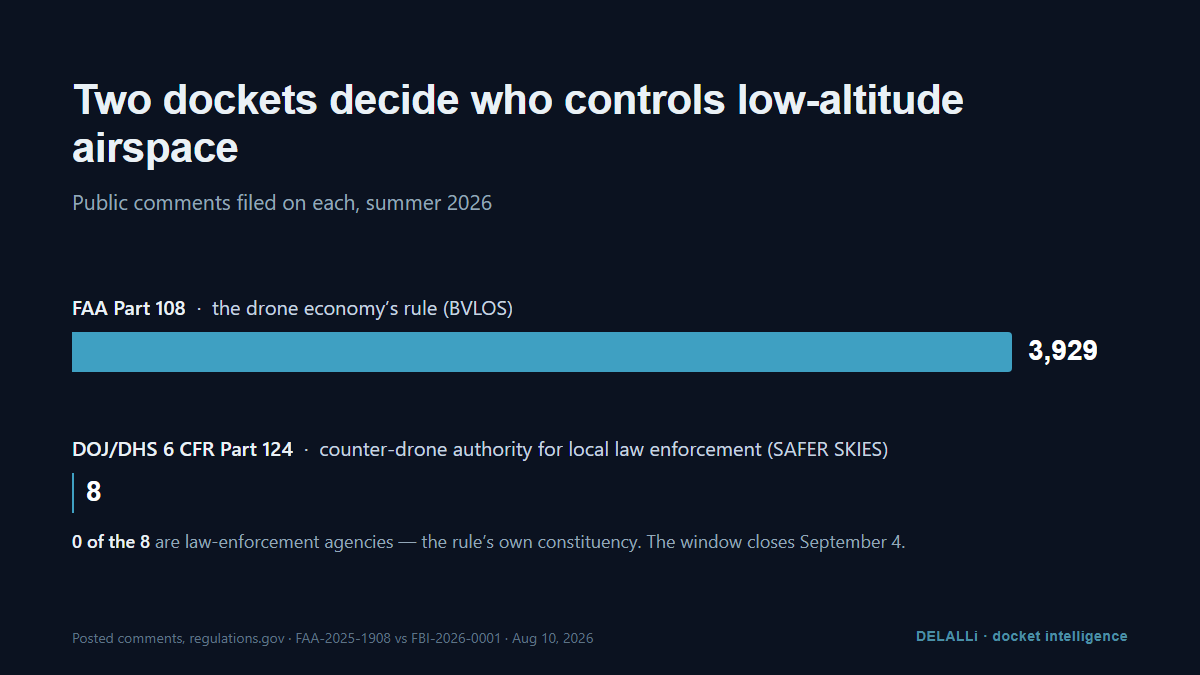 DELALLi graphic, built from the docket's own record — counts and retrieval dates are cited below.
I read all 21 comments, and every attachment. Here is the full census.
The first eight (July 6 through August 10):
- One vendor selling 12-gauge anti-drone tangler rounds, who filed a spec sheet.
- Five individuals: two with oversight questions (Fourth Amendment concerns, delegation safeguards), one man asking the most practical question on the record — who do I call when there's a drone incursion? — one supporting the rule and asking that it be extended to airport approach and departure paths and to energy infrastructure, and one opposing it as too open-ended to be safe for ordinary citizens.
- One security practitioner with thirty years of critical infrastructure assessment experience, who supports the rule but argues its centralized structure (national schoolhouse, interagency technology lists, layered approvals) is too slow for a threat that iterates in weeks.
- One tribal government (the Habematolel Pomo of Upper Lake), the only governmental commenter of any kind, arguing the rule's "covered facility or asset" scope is too narrow and framing counter-UAS within data sovereignty.
Then thirteen more posted on September 1, and they changed the docket's character without changing the thing that matters. Seven came from companies — among them Aeros (filing twice), Phinorm, Tactical Laser Defense Systems, Tiami Networks, and H2P Solution. Six came from individuals. None came from an agency.
Read together, the pattern in the late filings is hard to miss: most of them are arguing about the technology lists. Tactical Laser Defense Systems wants the Authorized Technologies List reopened, because as written its categories are exclusive. One individual asks that a category be added for non-electronic physical capture. Tiami Networks wants the criteria for building out the Authorized Systems List rewritten. Aeros wants RF mitigation held to directional, target-specific, minimum-power use, and separately wants § 124.3 amended to require continuous visual observation of the target and awareness of where debris falls.
These are serious comments, and several are better than serious — one comes from a Coast Guard veteran and former federal officer with counter-UAS experience in the National Capital Region. Aeros's debris-awareness point is the kind of operational detail the rule genuinely needs: where the aircraft and its payload come down is an operator's problem, not a footnote.
But look at what is being contested. The late arrivals are overwhelmingly about which equipment ends up on the approved lists, filed by people with a direct interest in the answer. That is what a procurement standard looks like while it is being written by sellers, with the buyers absent.
That's the record, with the clock running to September 4.
The docket is moving — it nearly tripled in a month. It is simply not moving in the direction you would expect. Twenty-one comments in, two months after the rule took effect, the agency column is still empty.
Why the silence matters
An interim final rule is already in effect. But the comment record shapes the final rule, and agencies that stay silent inherit whatever the record produces. Three ways to read the quiet:
- The lawyers are still writing. Institutional commenters routinely file in the last two weeks. If the associations (IACP, the sheriffs' associations, the corrections community) are coming, they arrive late. That is the normal pattern.
- Agencies assume someone else is handling it. Associations file so departments don't have to. Maybe. But on the parallel FAA drone rulemaking, 3,929 comments got filed and individual sheriff's offices and fire districts showed up in person. They know how to comment when they're paying attention.
- Agencies don't know this rule exists. The uncomfortable reading, and the one my time in this space keeps confirming. The SAFER SKIES Act passed inside a 1,000-page defense bill in December. The implementing rule dropped July 1. Most departments are absorbing it (if at all) through vendor marketing, not through the Federal Register.
Whichever reading is right, the outcome is the same. The rule that governs your training pipeline, your operations plan requirements, your audit obligations, and your technology options is being finalized on a record you didn't touch.
What agencies give up by not filing
The comments already on the docket press hard in one direction: more oversight, more safeguards, more judicial process around delegated authority. Those are legitimate concerns and some belong in the final rule. But nobody is filing the operator's side of the ledger. Nobody has told DOJ and DHS, on the record, what a 40-officer department can realistically staff. Nobody has said whether the certification structure works for a rural sheriff who shares a region with three other agencies. Nobody has flagged what mutual aid actually looks like at 2 a.m. when the drone is over the jail now.
Regulators cannot weigh input they never receive. A docket full of oversight concerns and empty of operational reality produces a final rule tilted exactly the way you'd expect.
What to do before September 4
If you run or advise an agency with counter-UAS exposure (corrections, stadium venues, critical infrastructure response, border-adjacent jurisdictions), three moves before September 4:
- Read the rule itself, not a summary. It's 6 CFR Part 124, and the two-tier structure (detection versus mitigation certification) is the piece most coverage gets wrong.
- File a comment, even a short one. A two-paragraph comment from a working sheriff describing staffing reality carries more weight in this record than anything a consultant writes. The docket takes submissions at regulations.gov until September 4.
- If you can't file, get your association to. Ask your state chiefs' or sheriffs' association whether they're commenting. The question itself moves the system.
We watch this docket daily and read every comment in full, including attachments. When the first agency or association files, that changes the record's character, and we'll report it.
(Where DELALLi sits in this: we educate and prepare agencies for what the rule requires. We do not certify anyone. Certification of mitigation authority runs through the FBI's National Counter-UAS Training Center (NCUTC), and nowhere else.)
Stay Informed on Drone Threats
Weekly intelligence on C-UAS developments, regulatory changes, and security insights from a Part 107 pilot and defense veteran.
Unsubscribe anytime. We never share your address — privacy policy.