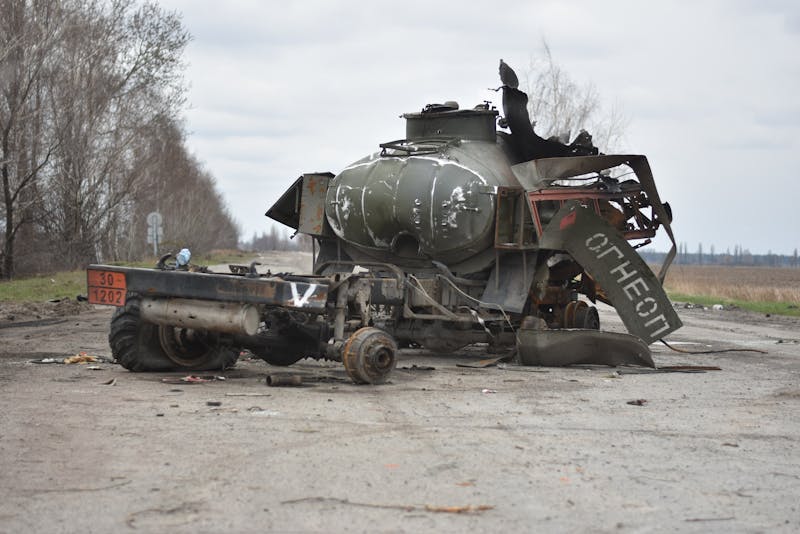
In Ukraine, operators—many in their late teens or early twenties—with video game controllers are destroying more Russian armor than entire artillery battalions.
Their weapons cost $500. The tanks they're destroying cost $5 million.
This isn't an anomaly. It's a fundamental shift in combat that has implications extending far beyond Eastern Europe.
The Data
Statistics that have caught Pentagon planners' attention:
70-80% of combat casualties in Ukraine are now attributed to drones.
65% of Russian tank losses are attributed to FPV (First Person View) drones.
200,000 FPV drones per month—Ukraine's current production rate.
$500—typical cost of a combat FPV drone.
$8-10 million—cost of an M1 Abrams tank. Several have been destroyed by FPV drones costing approximately $400.
The economics are straightforward: Ukraine can produce three million drones annually for the cost of a few hundred tanks. Those drones are destroying tanks at rates that would have seemed improbable five years ago.
The Evolution
FPV drones originated as hobby equipment. Racing enthusiasts built small, agile quadcopters with cameras transmitting live video to goggles, enabling high-speed flight through obstacle courses.
Then someone in Ukraine attached a munition.
The result: a precision-guided weapon costing less than a good restaurant meal. Unlike a Javelin missile (maximum range: 3 miles, cost: $178,000), an FPV drone can engage targets over 10 miles away. Unlike artillery, it can loiter, maneuver, and find vulnerable points in armor.
Unlike anything else on the battlefield, it can be manufactured in small workshops.
By early 2025, both Russia and Ukraine were deploying hundreds of these drones daily. The tactical implications were immediate: neither side could concentrate forces near the front line. Any grouping of troops or vehicles became a target within minutes.
Traditional armored warfare doctrine is being reconsidered.
The Counter-Countermeasure Cycle
Electronic warfare seemed to offer a solution. By late 2024, both sides were jamming approximately 75% of enemy FPV drones. The radio signals controlling the drones were being disrupted before reaching targets.
The adaptation: fiber optic drones.
Instead of radio control, these drones trail a thin fiber optic cable behind them—up to 15 miles of it. The cable transmits control signals and video. No radio means no jamming. No jamming means limited electronic defense.
Russia scaled production to over 50,000 fiber optic FPV drones per month by September 2025. Ukraine followed. A Ukrainian commander observed that "2025 will become the year of fiber-optics."
The innovation cycle that once took years now operates in weeks.
The Structural Challenge
The observation that defense strategists are processing: the most expensive military infrastructure in history is being countered by platforms built in small workshops.
Russian FPV drones have destroyed several American-made M1 Abrams tanks provided to Ukraine. Each Abrams represents decades of engineering and millions in investment. Each drone that destroyed one cost approximately $400.
Vice President J.D. Vance has noted that unmanned drone systems pose "a serious challenge to national security" and emphasized "the urgent need to equip U.S. forces with the tools and capabilities required to defend the homeland."
The observation is accurate. But the challenge extends beyond procurement.
U.S. military structure centers on platforms—aircraft carriers, fighter jets, tanks, artillery systems. These cost billions and require years to build. They're operated by extensively trained personnel and supported by substantial logistics.
FPV drones cost $500 and can be operated by anyone with gaming experience.
This isn't solely a technology gap. It's a conceptual gap. Adversaries have figured out how to make warfare economically efficient while established militaries continue optimizing for different cost structures.
The Adaptation Response
Military leadership is working to adapt.
War Secretary Pete Hegseth issued a directive requiring every Army squad to be equipped with unmanned systems by end of 2026. The Pentagon has ordered 30,000 drones with delivery expected by July 2026. By 2027, the plan calls for over 200,000 drones.
A billion dollars will fund manufacturing of approximately 340,000 small drones over two years.
There's a "Top Gun" school for FPV drones—participants train at Camp Atterbury in Indiana on Ukraine-style attack drones.
The context: while the U.S. orders 30,000 drones, Ukraine produces 200,000 per month. Russia does the same.
The procurement system operates on different timescales than the innovation environment.
Domestic Implications
The tactics being refined in Ukraine have domestic relevance.
ISIS used consumer drones to drop grenades on Kurdish fighters and French special forces in 2014. Cartels employ drones for surveillance and smuggling along the southern border. The FBI reports increasing drone incursions over U.S. military installations.
FBI Director Kash Patel announced creation of a National Counter-UAS Training Center specifically because "unmanned aircraft are increasingly exploited by criminals, terrorists, and hostile foreign actors."
DHS reports a 4,000 percent increase in drone activity around American stadiums.
Operations like Ukraine's "Operation Spiderweb"—where operatives transported FPV drones deep into Russian territory for coordinated strikes—demonstrate something significant: the capability relies on commercial hardware available to many actors.
When combined with AI-assisted targeting—which both Russia and Ukraine are deploying—these systems become more capable. The New York Times reported that in Pentagon war games, AI drone swarms are performing well.
Assessment
I spent years in Reconnaissance. I've observed weapons systems evolve. I've seen the military adapt to some threats and struggle with others.
Current observation: readiness gaps exist.
Counter-drone systems are designed around detection and jamming. Fiber optic drones defeat jamming. Air defense networks are designed around radar signatures. FPV drones are too small and numerous for effective tracking. Force structure assumes expensive platforms will dominate. Ukraine suggests that assumption needs reconsideration.
While procurement timelines proceed, adversaries are producing tens of thousands of $500 weapons systems monthly.
The defining characteristic of future combat may be the drone each soldier carries, not the rifle.
Recommendations
1. Decentralize drone production. Ukraine's strength isn't a single factory—it's hundreds of small manufacturers and volunteer workshops. A similar distributed capability merits consideration.
2. Accelerate iteration cycles. Pentagon acquisition takes years. The drone battlefield evolves in weeks. Testing, learning, and deploying faster seems necessary.
3. Invest in effective counter-drone systems. Jamming isn't sufficient when fiber optic drones exist. Layered defenses—electronic, kinetic, and AI-driven—are needed.
4. Universal drone training. Not just specialists. If every squad needs drone capability, every soldier needs drone proficiency.
5. Domestic protection. The World Cup is in six months. The Olympics are in 2028. FPV drone capabilities are documented in combat. Domestic venues require attention.
Summary
Ukraine didn't intend to revolutionize warfare. They were adapting for survival with available resources. The result may be the most significant shift in military technology since the machine gun.
A $500 drone can destroy a $5 million tank. An operator with goggles and a controller can defeat armor that took decades to develop. A fiber optic cable defeats electronic warfare systems costing billions.
This is current reality in Eastern Europe.
The question is whether these lessons get incorporated before they're applied elsewhere.
Brian Rutherford is a Marine Corps Reconnaissance veteran, combat veteran, and FAA-certified drone pilot who writes about drone technology, security, and emerging threats.
Sources
- FPV Drones in the Ukraine War: A Deep Dive — Defence Ukraine
- Drones Account for 65% of Russian Tank Losses — 19FortyFive
- Drones Now Account for 80% of Casualties in Ukraine-Russia War — Army Technology
- How Ukraine's Drone War Is Forcing the U.S. Army to Rewrite Its Battle Doctrine — Military.com
- Pentagon Signals New Era of Drone Warfare With $1B Ukraine-Inspired Push — UNITED24 Media
- The Pentagon Will Host a 'Top Gun' School for Ukraine-Style Attack Drones — Defense One
- Beyond the Drone Line: Lessons from the Drone War in Ukraine — European Security & Defence
- Moving Targets: Implications of the Russo-Ukrainian War for Drone Terrorism — Combating Terrorism Center at West Point
Stay Informed on Drone Threats
Weekly intelligence on C-UAS developments, regulatory changes, and security insights from a Part 107 pilot and defense veteran.
Join 500+ security professionals. Unsubscribe anytime.