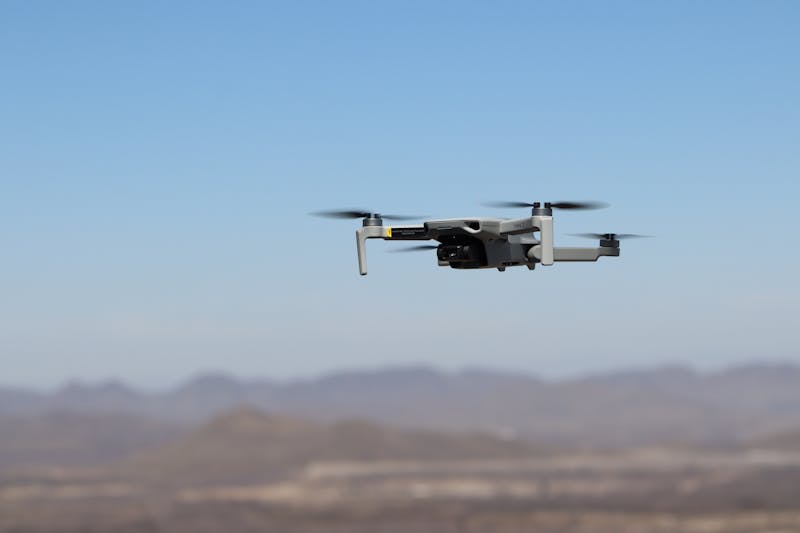
March 16, 2024. The FAA ended its discretionary enforcement policy for Remote ID violations.
The grace period concluded. If your drone weighing 0.55 pounds or more doesn't broadcast Remote ID, enforcement action applies.
In 2025, the FAA reported over 3,200 Remote ID violations. Twenty-two percent involved unauthorized flights in restricted areas. Fines reached up to $27,500 per violation. Commercial pilots lost certificates.
This is current enforcement reality, and 2026 continues the pattern.
Remote ID Requirements
If your drone weighs 0.55 pounds or more, it must broadcast identification and location information during flight. Real-time. Continuously.
The broadcast must include:
- Unique identifier (tied to your FAA registration)
- Drone location (latitude, longitude, altitude)
- Control station location
- Timestamp
Consider it a digital license plate that actively broadcasts identity and position to anyone with receiving equipment.
Compliance Approaches
Standard Remote ID drone. A drone manufactured with built-in Remote ID broadcast capability. Most drones produced since 2023 from major manufacturers include this. Check your model specifications.
Remote ID broadcast module. An aftermarket device attached to your drone that broadcasts the required information. Available for older aircraft without built-in capability.
FAA-Recognized Identification Area (FRIA). Designated locations where drones without Remote ID can operate legally. These are limited geographic areas, typically associated with community-based organizations or educational institutions.
If you don't fit one of these three categories, operations aren't compliant.
Enforcement Scope
The FAA's discretionary enforcement period gave operators time to upgrade equipment or acquire compliant drones. That window closed in March 2024.
Current enforcement includes:
Civil penalties up to $27,500 per violation. Not per flight—per violation. Multiple violations on a single flight multiply the exposure.
Certificate suspension or revocation. Part 107 commercial pilots can lose their remote pilot certificate.
Criminal referral. Egregious violations, particularly those involving safety concerns or repeated non-compliance, can result in criminal prosecution.
The FAA isn't conducting random inspections of every recreational flight. But when violations come to attention—through restricted airspace incursions, incident reports, law enforcement encounters, or aviation safety concerns—non-compliance with Remote ID adds to enforcement action.
2025 Violation Patterns
The FAA reported over 3,200 Remote ID violations in 2025.
Key patterns:
Restricted airspace flights (22%). Drones operating in controlled airspace without authorization. Remote ID makes these easier to identify and trace.
Registration lapses (18%). Expired or missing FAA registration, often discovered through Remote ID enforcement.
Commercial operations without current certification. Part 107 pilots flying commercially without maintaining current credentials.
The 95% compliance rate the FAA reports among commercial operators means 5% aren't compliant. With over 350,000 Part 107 certificate holders, that represents approximately 17,500 commercial pilots with potential exposure.
2025 System Changes
The FAA expanded digital verification systems. Where enforcement previously required catching operators directly, Remote ID provides persistent tracking and identification.
Expanded controlled airspace zones. Cities including Phoenix and Las Vegas saw expanded controlled airspace, requiring more operators to secure LAANC or other clearance before flying. Operating in these zones without authorization is now easier to detect.
Law enforcement access. Local law enforcement can access real-time drone tracking for certain operations. Encounters that previously required visual identification now include Remote ID data.
Coordination with airport authorities. Airport incursion investigations now routinely include Remote ID data analysis.
Equipment Considerations
If your drone doesn't have built-in Remote ID, you need a broadcast module.
Current market options range from $100-$300 for compliant modules. They add weight and require power, but they're the path to compliance for older aircraft.
If your module fails mid-flight, you're technically non-compliant for that portion of the flight. Relying on equipment failure as a defense isn't a strategy.
If your drone is incompatible with available modules—too small to carry them, no power output, or firmware conflicts—options are limited to FRIA operations or retirement of that aircraft for most uses.
FRIA Limitations
FAA-Recognized Identification Areas allow non-Remote ID drones to operate legally within defined geographic boundaries.
As of January 2026, over 700 FRIAs exist nationwide. Most are associated with AMA (Academy of Model Aeronautics) flying sites or educational institutions.
The limitations:
Geographic constraints. FRIAs are fixed locations. You can't create one for a job site or preferred area. You go to the FRIA or you don't get the exemption.
No commercial operations. FRIAs are designed for recreational and educational use. Commercial work still requires Remote ID compliance.
Application complexity. Establishing a new FRIA requires significant documentation and FAA approval.
For most commercial operators, FRIAs aren't relevant to actual operations.
International Context
The U.S. isn't alone in implementing remote identification requirements.
The UK implemented comparable rules effective January 1, 2026. The European Union has similar requirements under its UAS regulatory framework. Canada, Australia, and other developed aviation markets are implementing or planning equivalent systems.
Operators working internationally now face harmonized identification requirements.
The Part 108 Connection
Part 108—the FAA's new BVLOS rule—integrates with Remote ID requirements.
The operational freedoms Part 108 provides assume Remote ID compliance. Expanded beyond-visual-line-of-sight operations depend on reliable identification for safe integration with manned aviation.
Operators seeking Part 108 authorization without Remote ID compliance are blocked. The rules build on each other.
Cost of Non-Compliance
Calculate the exposure:
Direct fines. Up to $27,500 per violation.
Certificate action. Suspension or revocation of Part 107 certificate. For commercial operators, this affects livelihood.
Client consequences. Many contracts require proof of regulatory compliance. Non-compliance discovered afterward can void contracts.
Insurance complications. Policies may exclude coverage for operations conducted in violation of FAA regulations.
Reputational impact. Enforcement actions become public record.
Compare those costs to $100-$300 for a broadcast module.
Compliance Steps
Check your equipment. Verify whether your drone has built-in Remote ID capability. Manufacturer specifications and firmware updates provide this information.
If not built-in, add a module. Research compatible broadcast modules for your aircraft.
Verify registration currency. Remote ID broadcasts your registration number. If registration has lapsed, you're non-compliant on multiple fronts.
Understand controlled airspace. Know where you're flying. Use B4UFLY or equivalent apps.
Document compliance. Maintain records of equipment, registration, and operational procedures.
Assessment
The FAA's Remote ID enforcement is active. Over 3,200 violations documented in 2025. Fines up to $27,500. Certificates suspended and revoked.
The grace period ended in March 2024. The equipment is available and affordable. The requirements are clear.
Remote ID compliance is the baseline for legal drone operation in 2026. Everything else—Part 107 privileges, Part 108 opportunities, commercial contracts, insurance coverage—builds on that foundation.
Brian Rutherford holds an FAA Part 107 certificate and addresses regulatory requirements that operators should understand.
Sources
- FAA Ends Discretionary Enforcement Policy on Drone Remote Identification — FAA
- Remote Identification of Drones — FAA
- FAA Now Fully Enforcing Remote ID Rule for UAS Operations — NBAA
- FAA Remote ID Rule for Drones Takes Full Effect — Flying Magazine
- The Essential Guide to FAA Registered Drones in 2026 — Extreme Aerial Productions
- Remote ID is Here - What You Need to Know — Pilot Institute
- Understanding the FAA's Remote ID Rule for Drones — DroneFly
Stay Informed on Drone Threats
Weekly intelligence on C-UAS developments, regulatory changes, and security insights from a Part 107 pilot and defense veteran.
Join 500+ security professionals. Unsubscribe anytime.